Image
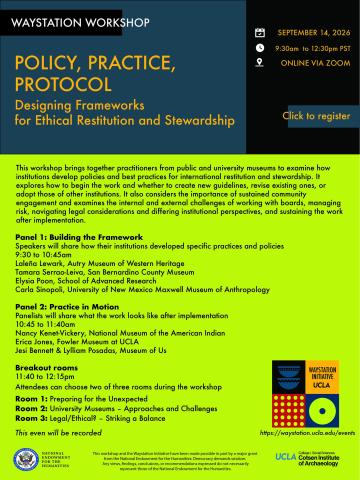

This workshop brings together practitioners from public and university museums to examine how institutions develop policies and best practices for international restitution and stewardship. It explores how to begin the work and whether to create new guidelines, revise existing ones, or adopt those of other institutions. It also considers the importance of sustained community engagement and examines the internal and external challenges of working with boards, managing risk, navigating legal considerations and differing institutional perspectives, and sustaining the work after implementation.
To register for the workshop, click HERE
Panel 1: Building the Framework
Speakers will share how their institutions developed specific practices and policies
9:30 to 10:45am
Laleña Lewark, Autry Museum of Western Heritage
Tamara Serrao-Leiva, San Bernardino County Museum
Elysia Poon, School of Advanced Research
Carla Sinopoli, University of New Mexico Maxwell Museum of Anthropology
Panel 2: Practice in Motion
Panelists will share what the work looks like after implementation
10:45 to 11:40am
Nancy Kenet-Vickery, National Museum of the American Indian
Erica Jones, Fowler Museum at UCLA
Jesi Bennett & Lylliam Posadas, Museum of Us
Breakout rooms
11:40 to 12:15pm
Attendees will be able to move between workshops.
Room 1: Expect the Unexpected – Anticipating and Overcoming Complications
Nancy Kenet Vickery
Jesi Bennett
Lylliam Posadas
Room 2: University Museums – Approaches and Challenges
Erica Jones
Carla Sinopoli
Room 3: Legal/Ethical? – Striking a Balance
Elysia Poon
Laleña Lewark
Tamara Serrao-Leiva
Closing remarks
Speaker Biographies
Jesi Lujan Bennett, Museum of Us
Dr. Jesi Lujan Bennett is Chamoru with familial ties to Dededo and Barrigada, Guåhan (Guam). She is the Director of Decolonizing Initiatives at the Museum of Us, creating policies and practices to redress the ways the institution participated in the colonial enterprise, both intentionally and unintentionally. Bennett is also a Post-Doctoral Research Fellow for Pacific Studies at the University of Auckland in Aotearoa (New Zealand) and the recipient of the Royal Society of New Zealand’s Marsden Fund for her project, “Chamoru Diasporic Routes: Sharing Our Elders' Stories from Sanlagu (Overseas).” Bennett studied at the University of Hawaiʻi at Mānoa and earned a PhD in American Studies and Museum Studies.
Erica P. Jones, Fowler Museum at UCLA
Dr. Erica P. Jones is the Senior Curator of African Arts and Manager of Curatorial Affairs at the Fowler Museum at UCLA. Since joining the Fowler, she has curated or co-curated many exhibitions including Meleko Mokgosi: Bread, Butter, and Power (2018), Inheritance: Recent Video Art from Africa (2019), and The House Was Too Small: Yoruba Sacred Arts from Nigeria and Beyond (2023). Jones is on the board of African Arts Journal and is the former co-chair of the Collaboration, Collections, and Restitution Best Practices for North American Museums Holding African Objects Working Group. Her publishing centers on colonial-era provenance and the arts of the Cameroon Grassfields.
Nancy Kenet-Vickery, National Museum of the American Indian
Nancy Kenet Vickery is a Senior Repatriation Analyst at the National Museum of the American Indian. She coordinates consultations and repatriations in partnership with Indigenous representatives and government officials to facilitate the respectful return of ancestral remains and cultural belongings. In addition to her work with U.S. Tribes and First Nations, she has coordinated repatriations to Indigenous communities in Cuba, Chile, and Ecuador. She has contributed to a range of museum initiatives that connect communities with their cultural belongings and currently serves as Co-Principal Investigator on a museum-wide initiative to expand pathways for return, including repatriation, shared stewardship, ethical return, and community loans.
LaLeña Lewark, Autry Museum of the American West
LaLeña, a citizen of the Cherokee Nation, leads the collections, conservation, and exhibitions departments at the Autry Museum where she is the VP for Collections, Conservation and Exhibitions. She is passionate about striving for ethical collections stewardship and innovation in the museum field. She had a pivotal role in the development and completion of the Autry’s Chrystina and James Parks Research Center for Archives, Conservation, and Collections Care facility that opened in 2022.LaLeña graduated with a BS in Historic Preservation from Southeast Missouri State University and a Certificate of Graduate Study in Museum Management from the University of South Carolina.
Elysia Poon, School of Advanced Research
With over two decades experience in the museum field, Elysia Poon's career has demonstrated a dedication to collaborative programming and community-based collections care. She currently serves as the Indian Arts Research Center executive director at the School for Advanced Research in Santa Fe, New Mexico. In this capacity, Elysia has helped facilitate the development of the Standards for Museums with Native American Collections and served as project facilitator for the groundbreaking nationally traveling exhibition, Grounded in Clay: The Spirit of Pueblo Pottery. Under her leadership, the IARC continues to be at the forefront of the national conversation around how collecting institutions and Native American communities can work together to foster and promote cultural heritage and further contemporary art practices.
Lylliam Posadas, Museum of Us
Lylliam is the Colonial Pathways Repatriation Manager at the Museum of Us, implementing consented stewardship and international and domestic repatriations that fall outside of NAGPRA. Lylliam has experience in repatriation in both public and private institutions and focuses on building capacity for repatriation including training, resourcing, policy, and advocacy. Lylliam is also co-founder of Your Neighborhood Museum, a non-profit organization of cultural workers with a mission to help each other care for our own cultural belongings and tell our own stories. BA in Anthropology and Psychology from UCLA and MSc in Technology and Analysis of Archaeological Materials from University College London.
Tamara Serrao-Leiva, San Bernardino County Museum
Tamara Serrao-Leiva is the Chief Deputy and former Curator of Anthropology at San Bernardino County Museum in southern California. After a decade of work in archaeology and CRM, Tamara transitioned into the museum field in 2015. Under her guidance, the museum has repatriated over 1000 objects back to their source communities. Since 2016, she has worked to develop a collaborative environment between various governments, both international and tribal, by establishing transparent communication regarding ancestors and objects in the museum’s care. Tamara is a Registered Professional Archaeology who holds an MA in Prehistoric Archaeology for the Universidad de Sevilla, Spain and a BA in Classical Archaeology from the University of California, Santa Barbara
Carla Sinopoli, University of New Mexico, Maxwell Museum of Anthropology
Carla Sinopoli is director of the Maxwell Museum of Anthropology and Professor of Anthropology at the University of New Mexico. An anthropological archaeologist, her archaeological research in South India spans from the study emergent hierarchical societies to historic empires, with a focus on crafting and political economy. As a museum anthropologist, Sinopoli is interested in the history of university museums and anthropological collecting, fostering community collaborations across all areas of museum work, and repatriation and ethical returns. Her curatorial work has resulted in exhibits and publications on such topics as colonial photography in the Philippines, early 20th century collecting in the Himalayas, Native American baskets, and university museum histories.